Reporte de caso de fasciolosis hepática en bovinos del municipio de Madera, Chihuahua
Palavras-chave:
Fasciola hepatica, bovinos, diagnósticoResumo
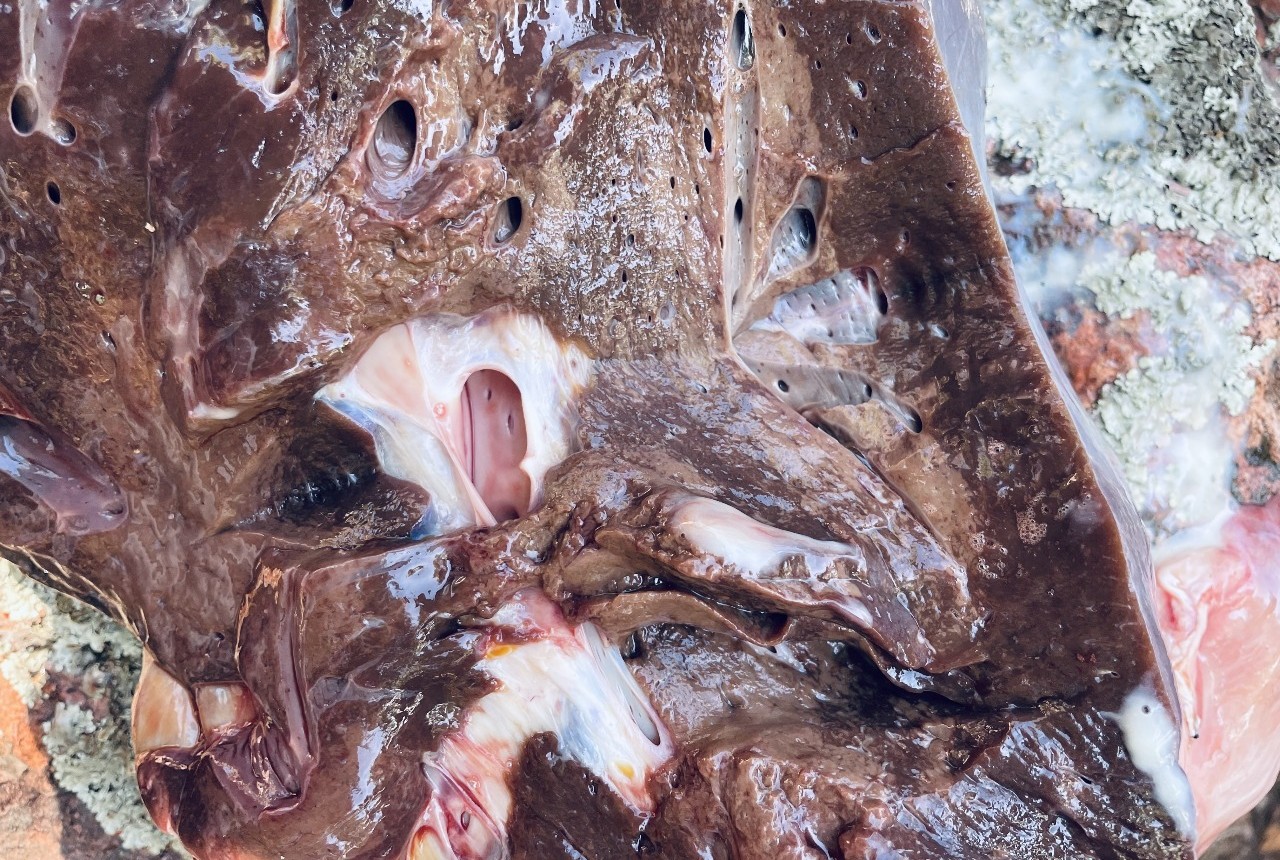
Se notifica la presencia de Fasciola hepatica en bovinos de una unidad de producción ubicada en el municipio de Madera, Chihuahua, México, caracterizada por un clima templado subhúmedo y con presencia de cuerpos de agua temporales. El caso involucró siete animales afectados, de los cuales cuatro presentaron postración y edema submandibular, y tres murieron. Los signos clínicos más relevantes incluyeron pérdida de condición corporal, pelo hirsuto, depresión, edema submandibular y mucosas pálidas, sin evidencia de fiebre, ictericia o diarrea. La necropsia reveló hepatomegalia, parénquima hepático pálido con necrosis focal, fibrosis, colangitis y presencia de duelas adultas en conductos biliares; adicionalmente se observó ligera ascitis y edema submandibular. El diagnóstico diferencial consideró edema maligno, leptospirosis bovina y deficiencia proteica severa; sin embargo, la confirmación se realizó mediante la identificación directa de F. hepatica en los conductos biliares y la correlación con los hallazgos clínicos y necroscópicos. El tratamiento consistió en la administración de closantel e ivermectina, suplementación vitamínico-mineral y medidas de manejo para reducir la exposición a hábitats favorables para el caracol intermediario (Lymnaea spp.). Este reporte resalta la importancia de la vigilancia sanitaria en zonas rurales de Chihuahua, la identificación temprana de la fasciolosis bovina y la implementación de estrategias integrales de control para minimizar pérdidas productivas y riesgos de reinfección.
https://doi.org/10.21929/abanicomicrobiano/2025.5
2025-5
Referências
ALVARADO N, Hernández BVM. 2001. Fascioliasis hepática: reporte de un caso y diagnóstico diferencial. Pediatr. Edición Int. 4(3):80–82.
https://pesquisa.bvsalud.org/portal/resource/pt/lil-343267
BABJÁK M, Königová A, Burcáková ?, Komáromyová M, Dolinská MU, Várady M. 2021. Assessing the efficacy of albendazole against Fasciola hepatica in naturally infected cattle by in vivo and in vitro methods. Veterinary Sciences. 8(11):e249.
https://doi.org/10.3390/vetsci8110249
CONABIO. 2025. Ecosistemas de México. Extensión y distribución. Comisión Nacional para el Conocimiento y Uso de la Biodiversidad. México.
https://www.biodiversidad.gob.mx/ecosistemas/ecosismex
CONAGUA. 2018. Atlas del agua en Chihuahua. Comisión Nacional del Agua. México. https://www.gob.mx/conagua/acciones-y-programas/publicaciones-estadisticas-y-geograficas-60692?utm_source=chatgpt.com
DRESCHER G, de Vasconcelos TCB, Belo VS, Pinto MMDG, Rosa JO, Morello LG, Figueiredo FB. 2023. Serological diagnosis of fasciolosis (Fasciola hepatica) in humans, cattle, and sheep: a meta-analysis. Frontiers in Veterinary Science. 10:e1252454. https://doi.org/10.3389/fvets.2023.1252454
EL-TAHAWY AS, Bazh EK, Khalafalla RE. 2017. Epidemiology of bovine fascioliasis in the Nile Delta region of Egypt: Its prevalence, evaluation of risk factors, and its economic significance. Veterinary World. 10(10):1241–1249.
https://doi.org/10.14202/vetworld.2017.1241-1249
FRIAS H, Maraví C, Arista-Ruiz MA, Yari-Briones DI, Paredes-Valderrama JR, Bravo YR, Cortez JV, Segura GT, Ruiz RE, Lapa RML, Valderrama NLM. 2023. Prevalence, coinfection, and risk factors associated with Fasciola hepatica and other gastrointestinal parasites in cattle from the Peruvian Amazon. Veterinary World. 16(3):546–553. https://doi.org/10.14202/vetworld.2023.546-553
GEDEFAW T, Mebratu AS, Dagnachew S, Fenta MD. 2025. Comparative analysis of anthelmintic treatments: impact on liver biomarkers and clinical recovery in sheep with fasciolosis. Frontiers in Veterinary Science. 12(2025):e1485568.
https://doi.org/10.3389/fvets.2025.1485568
GEURDEN T, Bartram D, Van Brussel L, Bo L, Scott-Baird E, Rugg D. 2012. Evaluation of the comparative efficacy of a moxidectin plus triclabendazole pour-on solution against adult and immature liver fluke, Fasciola hepatica, in cattle. Veterinary Parasitology. 189(2-4):227–232. https://doi.org/10.1016/j.vetpar.2012.04.019
GODINHO NM, Zomer-Spíndola CZ, Sangaletti-Lavina M, Lazaros-Chryssafidis A, Barbosa de Moura A. 2025. Contribution to an Efficient Diagnosis of Fasciola Hepatica Infection in Naturally Infected Cattle. Veterinary Parasitology: Regional Studies and Reports. 63:e101301. https://doi.org/10.1016/j.vprsr.2025.101301
HERNÁNDEZ-GUZMÁN K, Molina-Mendoza P, Olivares-Pérez J, Alcalá-Canto Y, Olmedo-Juárez A, Córdova-Izquierdo A, Villa-Mancera A. 2021. Prevalence and seasonal variation of Fasciola hepatica in slaughtered cattle: The role of climate and environmental factors in Mexico. Journal of Helminthology. 95:e46. https://doi.org/10.1017/S0022149X21000444
KAHL A, von Samson?Himmelstjerna G, Helm CS. 2023. Efficacy of flukicides against Fasciola hepatica and first report of triclabendazole resistance on german sheep farms. International Journal for Parasitology: Drugs and Drug Resistance. 23:91-105. https://doi.org/10.1016/j.ijpddr.2023.11.001
LAN Z, Zhang XH, Xing JL, Zhang AH, Wang HR, Zhang XC, Gao JF, Wang CR. 2024. Global prevalence of liver disease in human and domestic animals caused by Fasciola: A systematic review and meta-analysis. Journal of Global Health. 14:e04223. https://doi.org/10.7189/jogh.14.04223
MEHMOOD K, Zhang H, Sabir AJ, Abbas RZ, Ijaz M, Durrani AZ, Saleem MH, Ur Rehman M, Iqbal MK, Wang Y, Ahmad HI, Abbas T, Hussain R, Ghori MT, Ali S, Khan AU, Li J. 2017. A review on epidemiology, global prevalence, and economical losses of fasciolosis in ruminants. Microbial Pathogenesis. 109:253–262.
https://doi.org/10.1016/j.micpath.2017.06.006
MUNGUÍA-XÓCHIHUA JA, Ibarra-Velarde F, Ducoing-Watty A, Montenegro-Cristino N, Quiroz-Romero H. 2007. Prevalence of Fasciola hepatica (ELISA and fecal analysis) in ruminants from a semi-desert area in the northwest of Mexico. Parasitology Research.101(1):127–130. https://doi.org/10.1007/s00436-006-0438-y
MUNITA MP, Rea R, Martinez-Ibeas AM, Byrne N, Kennedy A, Sekiya M, Mulcahy G, Sayers R. 2019. Comparison of four commercially available ELISA kits for diagnosis of Fasciola hepatica in Irish cattle. BMC Veterinary Research. 15(1):e414. https://doi.org/10.1186/s12917-019-2160-x
OJEDA-ROBERTOS NF, González-Garduño R, Cornelio-Cruz S, Peralta-Torres JA, Luna-Palomera C, Machain-Williams C, Zarzad H, Torres-Chabléa OM, Reyes-Noveloc E, Baak-Baak C, Chay-Canul A. 2020. Factores asociados al decomiso de hígados positivos a Fasciola sp en una zona endémica del sureste de México. Revista Mexicana De Ciencias Pecuarias. 11(2):565–575. https://doi.org/10.22319/rmcp.v11i2.5173
OLSEN A, Frankena K, Bødker R, Toft N, Thamsborg SM, Enemark HL, Halasa T. 2015. Prevalence, risk factors and spatial analysis of liver fluke infections in Danish cattle herds. Parasites & Vectors. 8(2025):e160. https://doi.org/10.1186/s13071-015-0773-x
ROMÁN-PONCE S, Alvídrez-Hinojos F, Carrera-Chávez JM, GAC-CMD, Rojas-Anaya, E, Espinoza-Velasco B, Pérez-Ruiz E, García-Pérez JL. 2025. Análisis de prácticas tecnológicas en ranchos ganaderos del ejido Huizopa en el municipio de Madera, Chihuahua. Memoria del VII Congreso Internacional Abanico Veterinario, Agroforestal, Ambiental, Pesquero, Acuícola y del Mar. Pp. 118–123.
https://abanicoacademico.mx/revistasabanico-version-nueva/index.php/ciavapa/article/view/237
SABATINI GA, de Almeida Borges F, Claerebout E, Gianechini LS, Höglund J, Kaplan R. M, Lopes WDZ, Mitchell S, Rinaldi L, von Samson-Himmelstjerna G, Steffan P, Woodgate R. 2023. Practical guide to the diagnostics of ruminant gastrointestinal nematodes, liver fluke and lungworm infection: interpretation and usability of results. Parasites & Vectors. 16(1):e58. https://doi.org/10.1186/s13071-023-05680-w
TAKEUCHI-STORM N, Denwood M, Hansen TVA, Halasa T, Rattenborg E, Boes J, Enemark HL, Thamsborg SM. 2017. Farm-level risk factors for Fasciola hepatica infection in Danish dairy cattle as evaluated by two diagnostic methods. Parasites & Vectors. 10(1):e555. https://doi.org/10.1186/s13071-017-2504-y
Publicado
Edição
Seção

Este trabalho está licensiado sob uma licença Creative Commons Attribution-NonCommercial 4.0 International License.