Nematicidal activity of spent Pleurotus ostreatus substrate against Nacobbus aberrans and free-living nematodes
Keywords:
phytoparasites, edible mushrooms, natural productsAbstract
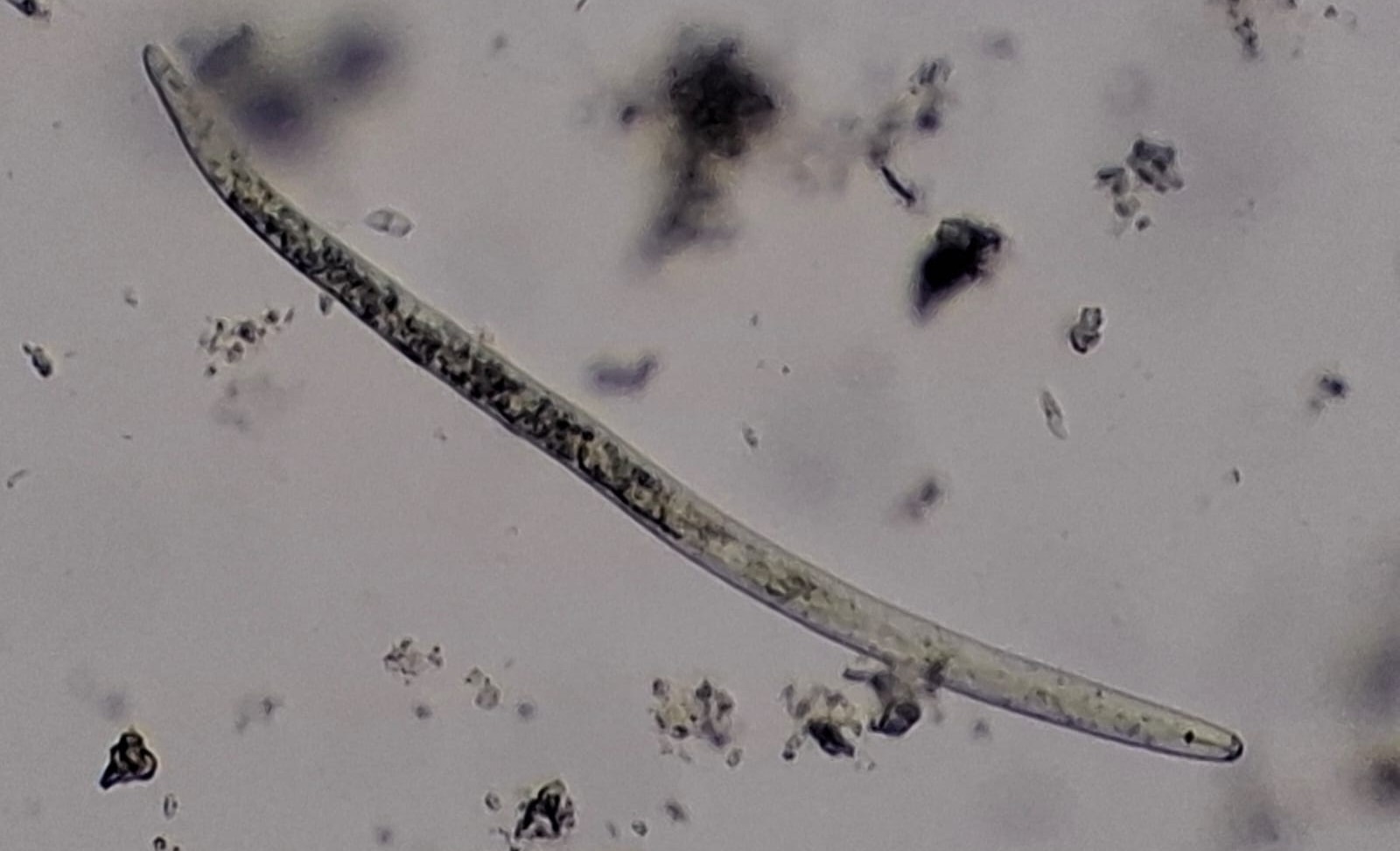
The phytonematode Nacobbus aberrans is a parasite of economic importance that affects various crops. Although chemical nematicides have been widely used for its control, their adverse effects on health, the environment, and non-target organisms have driven the search for more sustainable alternatives. In this context, the edible mushroom Pleurotus ostreatus constitutes a potential source of bioactive compounds with nematicidal activity. In the present study, the nematicidal effect of the crude hexanic extract of the spent substrate of P. ostreatus was evaluated on N. aberrans as a plant-parasitic nematode, and Caenorhabditis elegans and Panagrellus redivivus as free-living nematode models. In vitro assays were performed by incubating J2 larvae with four serial concentrations of the extract (1.25-10 mg/mL) for specific times (N. aberrans: 72 h; C. elegans: 24 h; P. redivivus: 17 and 24 h). The concentration of 10 mg/mL produced mortalities of 72.2% ± 3.6 in C. elegans, 57.0% ± 1.5 in P. redivivus, and 28.5% ± 2.9 in N. aberrans. These results indicate that the hexanic extract of spent substrate of P. ostreatus exerts an adverse effect on free-living nematodes, whereas its nematicidal activity is concentration-dependent.
https://doi.org/10.21929/abanicomicrobiano/2026.2
2026-02
https://www.youtube.com/watch?v=5fdAIP-nPaM
References
ARMAS-TIZAPANTZI A, Mata G, Hernández-Cuevas LV, Montiel-González AM. 2019. Estructuras tipo toxocistos en Pleurotus ostreatus y P. pulmonarius. Scientia fungorum. 49:e1250. https://doi.org/10.33885/sf.2019.49.1250
AVENDAÑO-HERNÁNDEZ RJ, Sánchez JE. 2013. Self-pasteurised substrate for growing oyster mushrooms (Pleurotus spp.). African Journal of Microbiology Research. 7(3):220-226. https://academicjournals.org/journal/AJMR/article-abstract/DB3EBDB17834
AYALA-MARTÍNEZ M, Ojeda RD, Soto-Simental J, Rivero PN, Meneses MM, Zepeda-Bastida A. 2015. Antibacterial activity of spent substrate of mushroom Pleurotus ostreatus enriched with herbs. Journal of Agricultural Science. 7 (11):225-231. https://doi.org/10.5539/jas.v7n11p225
BAAZEEM A, Alorabi M, Darwesh H, Alotaibi SS, El-Deen AN, Iqbal S, Naqvi SAH. 2022. Biological control of root-knot nematode (Meloidogyne javanica) by potential antagonism of endophytic fungi isolated from Taify roses. Journal of King Saud University – Science. 34(8):e102329. https://doi.org/10.1016/J.JKSUS.2022.102329
CEDEÑO-GARCÍA FJ. 2024. Incidencia de nematodos fitoparásitos y prácticas asociadas a su manejo en el cultivo de banano (Musa × paradisiaca L.) en el cantón Pueblo Viejo. Tesis de Licenciatura. Universidad Técnica de Babahoyo. Babahoyo, Los Ríos, Ecuador. Pp. 73.
https://rraae.cedia.edu.ec/vufind/Record/UTB_d3a880fa942117caa4750316604e13f2/Description
CHIN S, Behm CA, Mathesius U. 2018. Functions of flavonoids in plant-nematode interactions. Plants. 7(4):e85. https://doi.org/10.3390/plants7040085
CRISTÓBAL-ALEJO J, Mora-Aguilera G, Manzanilla-López RH, Marbán-Mendoza N, Sánchez-García P, Cid del Prado-Vera I, Evans K. 2006. Epidemiology and integrated control of Nacobbus aberrans on tomato in Mexico. Nematology. 8(5):727-737. https://doi.org/10.1163/156854106778877929
CRUZ-ARÉVALO J, Hernández-Velázquez VM, Cardoso-Taketa AT, González-Cortazar M, Sánchez-Vázquez JE, Peña-Chora G, Villar-Luna E, Aguilar-Marcelino L. 2024. Hydroalcoholic extracts from Pleurotus ostreatus spent substrate with nematocidal activity against Nacobbus aberrans Phytonematode and the non-target species Panagrellus redivivus. Plants. 13(13):e1777. https://doi.org/10.3390/plants13131777
DEL PORTE-ARGUETA R, Téllez-Téllez M, Acosta-Urdapilleta ML, Gómez-Rodríguez O, Wong-Villarreal A, Carreño-Campos C, Aguilar-Marcelino L. 2025. Sustrato degradado de Pleurotus ostreatus como nematicida de Nacobbus aberrans en plantas de chile (Capsicum annuum). Revista Mexicana de Fitopatología. 43(2):e64. https://doi.org/10.18781/R.MEX.FIT.2407-2
DESMEDT W, Mangelinckx S, Kyndt T, Vanholme B. 2020. A phytochemical perspective on plant defense against nematodes. Frontiers in Plant Science. 11:e602079. https://doi.org/10.3389/fpls.2020.602079
FRANCIS G, Kerem Z, Makkar HPS, Becker K. 2002. The biological action of saponins in animal systems: a review. British Journal of Nutrition. 88(6):587-605. https://doi.org/10.1079/BJN2002725
GENIER HLA, De Freitas-Soares EF, de Queiroz JH, de Souza-Gouveia A, Araújo JV, Riveiro-Braga F, Rebouças-Pinheiro I, Megumi-Kasuya MC. 2015. Activity of the fungus Pleurotus ostreatus and of its proteases on Panagrellus sp. larvae. African Journal of Biotechnology. 14(17):1496-1503. https://doi.org/10.5897/AJB2015.14447
GOMES EH, Soares FEF, Souza DC, Lima LT, Sufiate BL, Ferreira TF, Queiroz JH. 2019. Role of Synadenium grantii latex proteases in nematicidal activity on Meloidogyne incognita and Panagrellus redivivus. Brazilian Journal of Biology. 79(4):665-668. https://doi.org/10.1590/1519-6984.188129
GÓMEZ-RODRÍGUEZ O, Pineda-Alegría JA, Castañeda-Ramírez GS, González-Cortázar M, Sánchez JE, Aguilar-Marcelino L. 2022. Actividad nematicida in vitro de la fracción PdR-2 de Pleurotus djamor contra J2 Meloidogyne enterolobii. Revista Mexicana de Fitopatología. 40(2):254-262. https://doi.org/10.18781/r.mex.fit.2202-2
GONZÁLEZ-CORTÁZAR M, Sánchez JE, Huicochea-Medina M, Hernández-Velázquez VM, Mendoza-De-Gives P, Zamilpa A, López-Arellano ME, Pineda-Alegriá, JA, Aguilar-Marcelino L. 2021. In vitro and in vivo nematicide effect of extract fractions of Pleurotus djamor against Haemonchus contortus. Journal of Medicinal Food. 24(3):310-318. https://doi.org/10.1089/jmf.2020.0054
LAX P, Passone MA, Becerra AG, Sosa AL, Ciancio A, Finetti Sialer MM, Rosso LC. 2022. Sustainable strategies for management of the “false root-knot nematode” Nacobbus spp. Frontiers in Plant Science. 13:e1046315. https://doi.org/10.3389/fpls.2022.1046315
MARQUES-FERREIRA J, Neres-Carreira D, Ribeiro-Braga F, de Freitas-Soares FE. 2019. First report of the nematicidal activity of Flammulina velutipes, its spent mushroom compost and metabolites. 3 Biotech. 9:e410. https://doi.org/10.1007/s13205-019-1951-x
NJOM VS, Winks T, Diallo O, Lowe A, Behnke J, Dickman MJ, Duce I, Johnstone I, Buttle DJ. 2021. The effects of plant cysteine proteinases on the nematode cuticle. Parasites & Vectors. 14:e302. https://doi.org/10.1186/S13071-021-04800-8
OCAMPO-LÓPEZ J, Soto-Simental S, Ayala-Martínez M, Zepeda-Bastida A. 2021. Antibacterial activity of spent substrate of mushroom. In: AL-NAGGAR AMM (ed). Cutting-edge Research in Agricultural Sciences Vol. 6. BP International, India. Pp.136-147. eISBN: 978-93-90768-11-0. https://doi.org/10.9734/bpi/cras/v6/7475D
OCIMATI W, Were E, Tazuba AF, Dita M, Zheng SJ, Blomme G. 2021. Spent Pleurotus ostreatus substrate has potential for managing fusarium wilt of banana. Journal of fungi. 7(11):e946. https://doi.org/10.3390/jof7110946
PICA-GRANADOS Y. 2008. Ensayo de toxicidad con el nemátodo Panagrellus redivivus. En: Ramírez-Romero P, Mendoza-Cantú A, Ensayos toxicológicos para la evaluación de sustancias químicas en agua y suelo. México: Secretaría de Medio Ambiente y Recursos Naturales, Instituto Nacional de Ecología. Pp. 139-153.
http://centro.paot.org.mx/index.php/tematico/agua
PINEDA-ALEGRÍA JA, Sánchez J, González-Cortazar M, von Son-de Fernex E, González-Garduño R, Mendoza-de Gives P, Zamilpa A, Aguilar-Marcelino L. 2020. In vitro nematocidal activity of commercial fatty acids and ? -sitosterol against Haemonchus contortus. Journal of Helminthology. 94:e135.
https://doi.org/10.1017/S0022149X20000152
RODRÍGUEZ-MORALES D, Lozano-Jiménez YY, Sánchez-Mora RM. 2021. Caenorhabditis elegans como modelo de infección para el estudio de antimicrobianos. Nova. 19(36):109-132. https://doi.org/10.22490/24629448.5295
SÁNCHEZ-SALGADO SF, Castañeda-Ramírez GS, Sánchez JE, Gómez-Rodríguez O. 2021. Actividad nematicida in vitro de tres cepas de hongos comestibles de Pleurotus spp. contra Haemonchus contortus (L3) y Nacobbus aberrans (J2). Ibciencias. 4(1):9-13. https://www.revistas.unach.mx/index.php/ibciencias/article/view/224
SOARES FEF, Braga FR, Araújo JV, Geniêr HLA, Gouveia AS, Queiroz JH. 2013. Nematicidal activity of three novel extracellular proteases of the nematophagous fungus Monacrosporium sinense. Parasitology Research. 112:1557-1565. https://doi.org/10.1007/s00436-013-3304-8
SRINIVASAN J, Dillman AR, Macchietto MG, Heikkinen L, Lakso M, Fracchia KM, Antoshechkin I, Mortazavi A, Wong G, Sternberg PW. 2013. The draft genome and transcriptome of Panagrellus redivivus are shaped by the harsh demands of a free-living lifestyle. Genetics. 193(4):1279-1295. https://doi.org/10.1534/genetics.112.148809
TINOCO RI, Silva-Marrufo O, Castañeda-Venegas JA, Sida-Arreola JP. 2019. Eficiencia de mezclas para el control de nematodos a base de aceites esenciales de orégano, canela y extractos hidroalcohólicos de gobernadora. Revista de Ingeniería Biomédica y Biotecnología. 3(8):23-28.
https://www.ecorfan.org/taiwan/rj_ingenieria_biomedica_viii.php
VAN BEZOOIJEN J. 2006. Methods and Techniques for Nematology. Wageningen, Netherlands: Wageningen University. Pp. 118.
VERA-MORALES M, Castañeda-Ruiz RF, Sosa D, Arias-Vega C, Quevedo A, Ratti MF. 2024. Compuestos bioactivos de bacterias y hongos en el control de nematodos fitopatógenos: mecanismos de acción, interacciones y aplicaciones. Scientia Agropecuaria. 15(1):143-157. https://doi.org/10.17268/sci.agropecu.2024.011
WILSON MJ, Kakouli-Duarte T. 2009. Nematodes as Environmental Indicators. Wallingford, The United Kingdom: CABI Publishing. Pp. 341. ISBN: 978-1-84593-385-2.
YIN C, Fan X, Fan Z, Shi D, Yao F, Gao H. 2019. Comparison of non-volatile and volatile flavor compounds in six Pleurotus mushrooms. Journal of the Science of Food and Agriculture. 99(4):1691-1699. https://doi.org/10.1002/jsfa.9358
ZIED CD, Sánchez JE, Noble R, Pardo-Giménez A. 2020. Use of spent mushroom substrate in new mushroom crops to promote the transition towards a circular economy. Agronomy. 10(9): e1239. https://doi.org/10.3390/agronomy10091239
Published
Issue
Section
Copyright (c) 2026 Abanico Microbiano

This work is licensed under a Creative Commons Attribution-NonCommercial 4.0 International License.